In choosing a new-generation medical device housing manufacturer or an intricate aerospace structural part producer, technical procurement managers may encounter a particularly annoying vicious circle. The 5-axis CNC company chosen by virtue of its cheapest quotation usually turns out to have significant process control problems and frequent delivery delays during implementation. The final costs associated with “fire-fighting” efforts, quality disputes, and extended project schedule may exceed the originally planned budget up to 40%, thus seriously undermining the profitability of a project and its supply chain reliability.
What happens is that the classic procurement approach excessively concentrates on the so-called “sticker price” while entirely neglecting such factors as the Total Cost of Ownership (TCO), which encompasses costs related to high scrap rates because of inadequate process control capacity, change management and validation costs due to immature quality systems, and risks associated with project schedule owing to supply chain opacity. The perception of highly sophisticated manufacturing of 5-axis CNC parts as a commodity is one of the root causes of this danger. In this article, we will introduce a “Supplier Selection Model for TCO-Based Risk Assessment and Management.“
Why Is the “Lowest Price” Frequently Associated With the Highest Total Cost of Ownership?
What appears to be a cheap 5-axis machining bid may actually come at a huge cost through a “performance debt” in four important ways: poor-quality products (scraps or reworks), delays in projects, expensive changes due to inadequate DFM partnerships, and safety stock needed as a hedge against potential supply problems. Optimizing the supply chain entails looking beyond unit cost to total cost since losses arising from supplier inefficiencies can easily dwarf purchase costs. For a methodical examination, a well-developed evaluation approach will prove invaluable. A detailed guide on 5-axis CNC parts manufacturing offers an all-encompassing audit checklist.
- Hidden Cost of Quality Problems: The cost of quality problems in procurement projects is not limited to disposing of a small number of defective pieces. It encompasses the cost of stopping assembly lines, fast shipping, and the effort required for sorting and re-inspection. In cases where the manufacturing process of an expensive, critical component fails in batches, the potential savings from a low-cost bid will be lost immediately. Although these hidden costs are not considered during initial price negotiations, they directly impact the project’s profitability and timeline.
- Delays and Losses in Revenue Opportunities: When a supplier struggles to control its production capacity or project scheduling, several other delays occur. Every delay in delivering the product part causes further delays in assembly, testing, and validation activities. In some cases, the delay in these processes causes missed opportunities, such as missing the launch window or failing to submit within the regulatory timeline, which translates to significant losses that surpass any savings from piece-parts.
- The Hidden Tax of Internal Engineering Resources: A provider without sufficient technical depth will be unable to serve as an engineering partner. With no technical analysis in the form of DFM, the responsibility for discovering and resolving issues related to manufacturability lies entirely upon the engineering staff of the company. This incurs hundreds of precious man-hours, which represent a significant and hidden cost, as it is never included in the quote from the provider and yet affects the productivity and innovation speed of the company.
What to Look for to Test the “Technical Certainty” of a Supplier Besides Their Machines?
True technical certainty in 5-axis precision machining is not about having the latest machine but a method for turning complicated designs into conforming parts reliably and reproducibly. Testing such a certainty will require moving beyond merely checking the list of machines possessed by the provider and evaluating its process design and validation practices regarding manufacturing of complex parts. The focus here should be on assessing the ability of the provider to systematically overcome manufacturing problems.
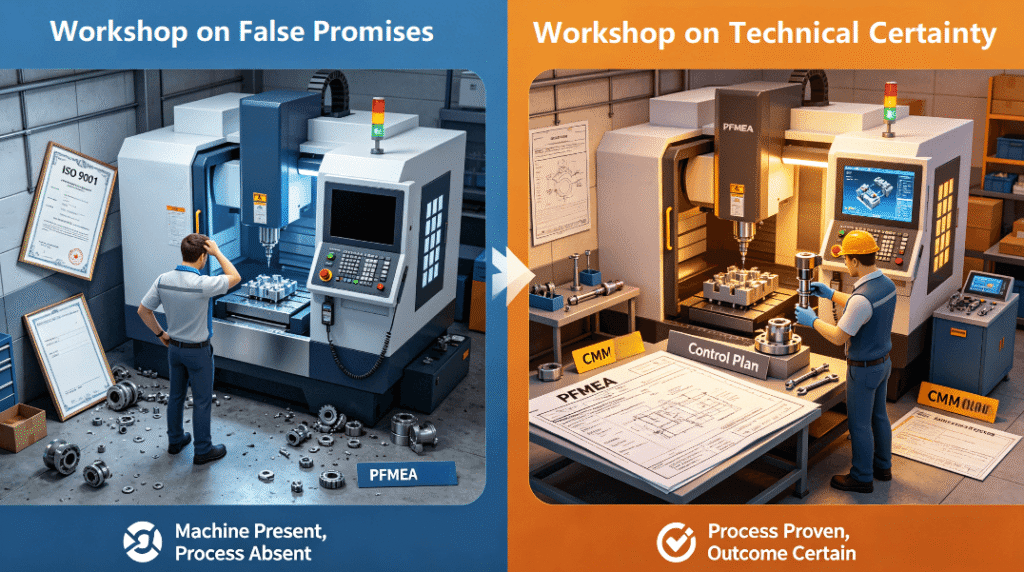
1. Demand Process FMEA & Control Plans as Proof, Not as a Promise
Do not be satisfied with vague promises. Ask for Process Failure Mode and Effects Analysis (PFMEA) and Control Plans of similar parts to yours in terms of geometry, material, and tolerance. Insist that the supplier provide you with actual reports of CMM inspection results from previous batches rather than first articles. From the documentation, it will be clear whether they know possible failure modes and whether they have already implemented control methods – proof of their advanced technological processes and forward thinking.
2. Question Their Digital Problem-Solving Capacity
The cutting-edge capacity of any supplier lies in digital domain. How do they use CAM simulation software? Do they verify toolpaths, material removal, and cycle times with simulations? Do they take into account thermal and vibratory effects in long cycle time projects with simulation software? It will become evident whether they virtually solve the problems or find them out on the shop floor.
3. Evaluate the Problem-Solving Approach for New Problems
Provide a specific technical problem from your part, such as wall thinning problems and surface finish requirements on difficult materials. Analyze their problem-solving process. Do they immediately provide some type of tooling solution, or do they look at other factors such as fixtures, machining parameters, and measurement during processing? Their problem-solving process will let you know if they rely on luck and experience or a more engineering-based, deterministic process.
Is Their Quality System a “Paper Tiger” or an Organizational Culture?
An ISO or IATF 16949 certificate hanging on the wall is meaningless. The audit should prove that this is a living organization where a quality assurance system is fully embraced as part of the culture within their company. This means emphasis must be placed on actions rather than just documentation. The quality assurance system itself provides the basis for stability. When a company follows the IATF 16949 standard, for example, it shows that the supplier has systems for the prevention and correction of nonconformances. This is fundamental to process control.
1. Follow a Non-Conformance through its Lifecycle
This involves more than simply checking the quality manual. Request to examine an NCR along with its corresponding 8D report. Follow the entire process from when the issue was first detected, through root cause analysis, corrective and preventative measures, their implementation, and proof of success. This cyclical approach will reveal if the system is being utilized to permanently address issues or simply to capture the non-conformances. This is one of the most reliable ways to assess the health and vibrancy of a quality culture.
2. Audit the “Gemba” – The Physical Location of Work
On the production line, observe how the quality system manifests itself visually. Is the calibration information of any measuring instruments visible on the machine? Has the latest version of work instructions been posted? Is there a visible way to determine the stage of the material (raw, process, inspected)? These visual management techniques and standard work practices are signs of a culture that is proactive, not reactive, about maintaining quality.
3. Determine if the Quality Department is Independent and Authoritative
Find out whether the quality department has authority over production stoppages. Ask about the chain of command of quality control managers. Are they separate from production managers? Check whether the first-article inspection is being done by qualified quality inspectors rather than the operator stamping out his or her own work. The independence of these two activities is vital for an objective inspection, which is a feature of a good quality management system.
What Does Operational Synergy Mean in a Critical Manufacturing Alliance?
Operational synergy is turning an ordinary supplier into a functional part of your enterprise. This is expressed in terms of mutual transparency, clear communication, and synchronization of your business cycles. This involves assessing how the supplier is incorporated into your workflow to minimize any uncertainty and ensure smooth processes. The partner with a higher level of operational synergy, despite having higher costs per unit, will be worth your while.
1. Examine Project Management and Transparency of Communications
When you evaluate a potential partner, make sure they can prove their project management capabilities with a tool demonstration. Can they show you a live hosted dashboard where you can see not only the progress of your project but also the key milestones and potential risks? Do they offer to give you the primary contact who will be available to sort out any problems that arise? Transparent communication and good change management become two of the main pillars supporting complex projects. They help to avoid misunderstandings and delays, which can be very expensive. On the other hand, pricing differences that are not very significant do not cause much trouble.
2. Review Their Approach to Capacity Planning and Sensitivity to Demand
Talk to them about their capacity management concept. Does their organization have a dedicated cell to conduct prototypes and actual manufacturing? How do they combine their rush production with regular projects? An ideal partner will be ready to collaborate with you regarding capacity and demand, taking a long-term look on things and not being a bottleneck when it comes to ramp-up.
3. Measure the Benefits of Proactive Risk Mitigation
The benefit of synergy lies in savings from avoiding problems. Synergistic partners will proactively recognize and bring up alternative solutions for lead time risks. Synergistic partners will recognize an overly tight tolerance that can be relaxed during the DFM stage, saving cost. Synergistic partners will voluntarily update you on the progress of your project. Synergy will allow you to minimize the “tax” you are paying in the form of constant back-and-forth emails and emergency calls.
From Risk to Resilience – Case Study on Semiconductor Equipment
A practical example demonstrates how the framework enables the conversion of an urgent supply chain risk into a sustainable competitive advantage. The semiconductor equipment company suffered significant project delays since two of its previous suppliers were unable to machine a baseplate of a carbon fiber composite (CFRP) wafer handler with an extremely tight flatness tolerance of 0.01mm and precisely drilled holes. The difficulty of machining was associated with avoiding delamination of the part as well as micron accuracy in drilling. The project was salvaged not through a more affordable bid, but due to the solution provided by the supplier. The supplier performed special materials research, developed its own PCD tools, invented a low-stress holding device, and introduced an in-process probing technique. The part was produced perfectly on the first trial, complying with all requirements and saving the customer’s time. Hence, for critical components, a proper partner can provide not only parts but also deterministic risk mitigation.
- The Cost of Supplier Failure to Innovate: From the client’s past experience with different suppliers, another key cost associated with supplier failure should be noted: the cost of innovation delay. When working with failed suppliers, it involves not only lost money but also lost time spent on researching, developing innovations, and realizing their economic potential. In this case study, the importance of having a highly-capable supplier of 5-axis machining services is clearly evident in terms of innovative products. Focusing on price alone may result in the failure of innovating.
- De-risking through Intensive Technical Collaboration: The solution to the problem was found through deep technical collaboration. The supplier was not only quoting prints but was a manufacturing partner who offered solutions to the client’s physical challenge. This meant that a team of experts was needed to analyze materials, develop custom fixtures, and create an optimized machining sequence that relieves stresses in the material being processed. Such an approach is opposite to transactional buying and is necessary for innovation.
- Building Strategic Trust Based on Success: In addition to supplying one part successfully, there was the creation of strategic trust. The client certified the supplier as a global partner. What is shown here is the value of going from being a risk-based vendor to being an extension of the client’s manufacturing capability based on success. It goes beyond just price per part and involves both parties investing in success, where the technical capabilities of the supplier become an asset to help answer the question of choosing a 5-axis CNC supplier.
How to Structure a Win-Win Partnership Agreement for the Long Term?
The contract for partnership ought to communicate all the expenditure of time that you have put in evaluating a supplier and negotiating an Asian deal. More than just issuing of price lists, a strategic on-going agreement is a basis for the two partners to jointly make investments in process optimization and capacity planning. In fact, it means setting up your contract so that it not only solves the current issues of both parties but also leads to new opportunities for growth and success. Hence, the supplier will no longer become a cost source that needs management. In other words, to build a strategic alliance, you will need to go above and beyond transactional cooperation towards deeper integration of value. Being an IATF 16949 and AS9100D certified 5-axis CNC machining supplier, the essence of the company lies in developing strategic partnerships with customers by focusing on their needs, synergies of engineering, and transparency of cost model to solve some of the toughest manufacturing problems.
1. Evolving Beyond Transactional Pricing Approaches
Explore options that evolve beyond just purchase orders. Approaches such as cost transparency and gain-sharing will work for you; you’ll set up a transparent cost structure (material costs, machine costs, labor costs), and a target cost. You’ll share any savings that the supplier generates through implementing innovative methods and reducing costs below the target cost. Such an arrangement creates mutual motivation to improve and innovate rather than haggle over each last penny.
2. Joint Investments in Specific Capacities and Tooling
For longer volume programs, explore co-investments in specific tooling, specific fixture, or even a manufacturing cell dedicated to producing parts for you. It guarantees you prioritized access, while ensuring the supplier a known capacity utilization level. Set up formal agreements on capacity reservation and forecasting needs. In addition, joint investments help eliminate commercial risks associated with the supplier’s equipment and reduce their need for capital investment.
3. Governance and Continuous Improvement Cycles
Every strategic partnership requires formal governance mechanisms. A steering committee that is set up together can meet at least four times a year to touch base on main performance indicators (quality delivery cost, innovation) and plan ways to enhance them. Besides, it is possible to embed a supplier development program into the contract and delegate some staff members to parts of the training or coaching. This sort of collaboration is able to provide a regular change and even greater advantages, being the basis for a flexible and innovative supply chain.
Conclusion
Picking the right CNC manufacturing partner is a very strategic matter as it determines product performance, production cost, and time to market. If you conduct an evaluation using Total Cost of Ownership, perform comprehensive audits, and consider potential synergies, purchasing managers will be able to develop a proactive ability to convert this major decision into a key supply chain strengthening function. Rather than continuously driving costs down, the main goal should be to sign a trustworthy partnership that can effectively de-risk innovations and ensure uninterrupted product launch.
FAQs
Q: How long would it reasonably take to onboard and qualify a new 5-axis CNC machining partner for a major project?
A: A thorough qualification process will span 8-12 weeks, it involves capabilities review, technical assessment, onsite evaluation, and sample parts production with inspection. Rushing the due diligence phase can cause significant project risks, since it is a point of technical qualification and suitability for production among other things.
Q: How can we justly compare bids from suppliers if their quote formats differ greatly?
A: Use a standard format that requires all bidders to give a detailed breakdown of their prices, such as material programming machining time tooling surface treatment, and inspection. Furthermore, it is very important to include the suppliers’ engineering risks assessment, where suppliers will highlight the challenging aspects of the design.
Q: Which are the most relevant certifications to verify, and are they all equally important?
A: As a bare minimum, get a quality management system document certified against ISO 9001. Industry specific certifications are of great significance: IATF 16949 for automotive, ISO 13485 for medical devices, and AS9100 for aerospace. Besides, after scope of the certification, audit is to be carried out to verify the status of the standards implementation by the company in their day-to-day operation. Also, certification alone is just a starting point, less than that, it may indicate whether the company is really implementing the standards in operation.
Q: Is it possible to have a single supplier that can meet our demands in both low-volume prototyping and high-volume production?
A: This may be possible, but one must do a very thorough evaluation. The most suitable supplier will have separate production and prototyping departments or cells. Low-volume prototyping demands flexibility and the involvement of engineers, while high-volume manufacturing is mostly about optimization and automation. Therefore, we should evaluate their organizational set-up and capacity management during the audit.
Q: What process do we follow for handling IP protection while communicating design specifics to our prospective supplier?
A: Always begin with an appropriate NDA agreement. If it is a highly confidential project, follow a staged information delivery process by providing simpler design information for quoting purposes, and deliver the whole design information only after selecting your supplier. Most trusted suppliers possess state-of-the-art security systems that include IP protection measures.
Author Bio
The author has more than 15 years of experience in designing and implementing the supply chain strategy and supplier develment for high-tech manufacturing companies, with a focus on developing manufacturing ecosystems for technology companies which possess a high level of technical expertise and reliable quality. The team led by the author at LS Manufacturing is famous for creating collaborations with the best precision manufacturers around the world. If you are considering potential partners for 5-axis CNC manufacturing and require a thorough evaluation of the suppliers’ capabilities, you can contact them to provide a custom analysis.