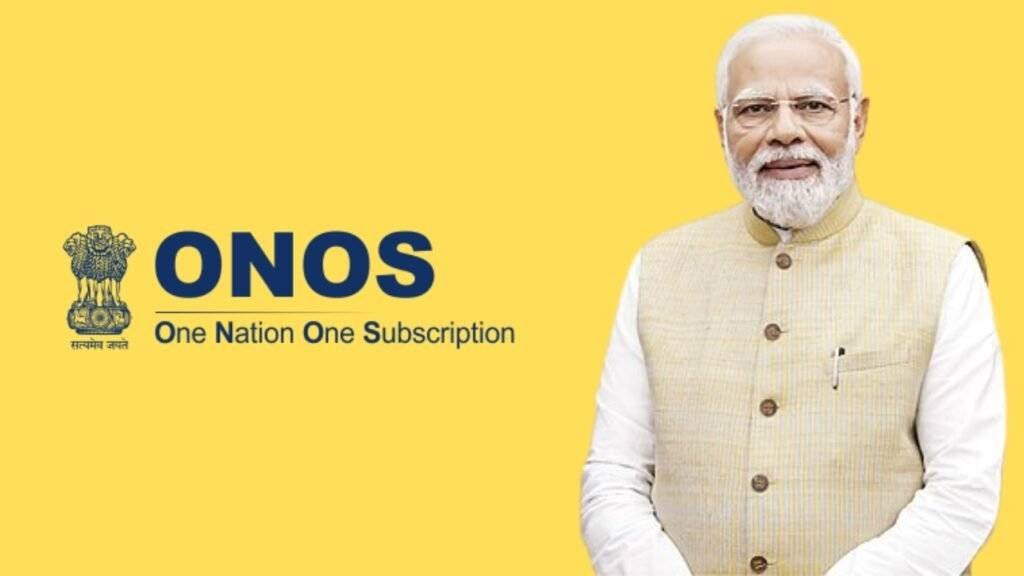
India is slowly but surely headed toward being a powerhouse for knowledge in the world, there has always been one challenge that stood in its way: access to academic and research resources. To address this problem, the government approved the implementation of One Nation One Subscription (ONOS), a robust central system to facilitate affordable and equitable access to scholarly content across the country.
What is the One Nation One Subscription scheme?
ONOS is a government initiative providing access to premium academic journals, research papers & digital libraries under one subscription across the country.
Rather than individual colleges and universities paying individually for expensive journal subscriptions, the government negotiates with international companies and allows centralized access to all qualifying institutions. Such availability allows students and researchers alike across India to retrieve the same good quality informative content.
Goals of One Nation One Subscription
The ONOS initiative aims to fill the gap with three prime objectives directly benefitting India’s education and research ecosystem:
Equal Access to Knowledge
To democratise access to premium academic resources for every student and researcher, no matter their institution’s financial strength.
Promote Research and Innovation
To facilitate high-quality research output by enabling access to worldwide journals and new findings.
Reduce Financial Burden on Institutions
To aggregate negotiations and payments to lower subscription costs.
Strengthen Digital Education
To facilitate the digital transformation of India by providing educational content online.
Improve Global Academic Ranking
To improve the standard of research articles and citations to enable Indian institutions to rank better on a global scale.
Eligibility Criteria for ONOS
The ONOS initiative will provide the institution access to a broader range of educational and research institutions across India. Here is the basic eligibility:
Recognized Educational Institutions
- Central Universities
- State Universities
- Such as Private Universities (which are approved by bodies like UGC or AICTE)
Colleges and Higher Education Institutes
- Government colleges
- Affiliated colleges
- Autonomous institutions
Research Organizations
- Government-funded research institutes
- Scientific and technical research centers
Faculty and Students
- Professors, researchers, and academic staff
- Undergraduate, postgraduate, and PhD students
Government Approval Requirement
Recognition must be done by the appropriate regulatory authority for institutions to enter into ONOS.
Important Documents Required
Even though it is a mostly institutional-level project, there are some documents or details that the system might ask you for to register or access:
Institutional Documents
- Accreditation certificates (UGC/AICTE approval)
- Institutional registration details
- Official domain/email verification
User Identification
- Student ID or faculty ID
- Institutional email ID
Authorization Letters
- Approvals for setting up access from the institution authorities
- Nodal officer details for coordination
Technical Requirements
- Internet-enabled devices
- Contact details for the ONOS platform
How to Apply for One Nation One Subscription
As ONOS is a centralized effort the application process primarily takes place at the institutional level. Here’s how it typically works:
Government Registration of Institutions
Eligible institutions are recognised under the ONOS scheme, and the government registers these institutions.
Step 2: Institutional Registration
You can register on the official ONOS platform with your credential and required documents.
Step 3: Verification Process
Details submitted are verified by the concerned authorities to check for eligibility.
Step 4: Access Setup
After approval, institutions are granted access and share it with their students and staff.
Step 5: User Login and Access
Students and faculty log in with institutional IDs to access journals, e-books, and research databases.
Step 6: Training and Awareness
This ensures everyone is familiar with the system and its features.
Key Benefits of ONOS
Democratization of Knowledge
Students attending rural and underfunded institutions will have the same access to resources as students at elite universities.
Cost Savings
Centralized subscriptions make it less expensive for individual institutions.
Better Research Opportunities
It gives researchers access to the latest global studies, thus bettering the quality of their findings.
Enhanced Learning Experience
Credible sources that students can utilize for assignments, projects and competitive exams preparation.
Increased Collaboration
Open data fosters collaboration across institutions and researchers.
Challenges in Implementing ONOS
Well, there are a few challenges:
High Initial Investment
A big budget for the government is required to have it subscriptional across the country. Publisher deal negotiation is such an advantage.
Publisher Resistance
However, there are many global publishers who would not subscribe to such a massive discount or flexible conditions that might shake up their revenue models.
Infrastructure Limitations
Not all institutions come with strong digital backbone. Providing consistent access in limited urban areas is no small task.
Awareness and Training
Access must be complemented by real training in how to use these resources effectively for students and faculty. It would become completely unutilized if nothing was done to promote it.
ONOS vs Traditional Subscription Model: A Comparison
One Nation One Subscription (ONOS) is a game changer that will distance academia from the existing system of access to academic resources in India. Knowing the difference between those two models guides us to reveal the ground-breaking nature of ONOS.
Cost Structure
Under the traditional subscription model, separate subscriptions to journals and databases have to be bought by individual institutions – universities and colleges. This can lead to frustrated and repetitive high costs for smaller institutions with tighter budgets.
Through ONOS, government signed one master/centralized subscription deal that covers multiple agencies significantly reducing overall costs through bulk agreements. This promotes affordability and sustainability of access.
Accessibility
Traditional subscriptions restrict access to only those institutions that can pay for it. This means that an increasing number of students and researchers may not have access to premium academic content.
By contrast, ONOS guarantees equal access for all eligible institutions, independent of financial or geographic advantage. It fosters a more inclusive learning environment.
Resource Availability
Under the old model, institutions tended to subscribe only a small number of journals — there was only so much money available for copying. This limits the research and the learning scope.
ONOS provided users with a single platform to access all the journals, e-books, and databases available on their system; enabling them to surf an abundance of knowledge.
Administrative Burden
The complex and multi-subscription traditional world means renewals, negotiations, offices full of vendor management.
The ONOS approach does this by centralizing management and significantly offloading administrative overhead on institutions.
Equity in Education
Traditionally, this model has sparked a divide between better-funded and underfunded institutions, creating discrepancies in the quality of learning opportunities.
ONOS is an investment in bridging this equality gap, as it provides every student access to the same high-quality resources.
Long-Term Impact
Whereas the traditional model simply propped up a few institutions, ONOS has the capacity to revitalize education system-wide by enhancing research quality, collaboration and innovation across an entire nation.
Role of Libraries in ONOS
Libraries have long been the backbone of academic institutions, acting as gateways to knowledge. Rather, the advent of One Nation One Subscription (ONOS), means that the role of libraries would evolve rather than diminish.
From Offline to Online Access
Historically, libraries were about holding physical books and journals. With ONOS, they will become more of a digital knowledge hubs where there is access to online journals, databases and e-resources.
Facilitating Access to ONOS Resources
Students and faculty will be using the ONOS platform to support their research and libraries are going to need to help them navigate it. They will serve as support centers to educate users on searching, downloading and using academic materials.
Training and Awareness Programs
Libraries will be required to conduct workshops, training and awareness programs. These programs will help the users learn how to use the tremendous amount of resources that should be available through ONOS.
Also Read: Amrit Bharat Station Scheme | Pradhan Mantri Jan Dhan Yojana | Pradhan Mantri Fasal Bima Yojana
Research Support Services
Modern libraries won’t just provide access. They will assist researchers with:
- Literature reviews
- Citation management
- Plagiarism checks
- Data sourcing
This critical role makes libraries integral to the research ecosystem under ONOS.
Bridging the Digital Divide
Out in many rural or underdeveloped parts, students may not have direct access to digital devices or high-speed internet. Libraries can serve as access points, investing in computers and internet connectivity to make sure no one is left behind.
Collaboration and Knowledge Sharing
Libraries provide the means for students as well as scholars to collaborate, by providing common dwelling spaces of learning and discussion; virtual or real-world research environments where peers can meet and trade ideas.
Preservation of Knowledge
Libraries will continue to be important custodians of valuable academic and historical resources, regardless of digital models like ONOS.
Evolving Role of Librarians
Professionals working as librarians will become information specialists and digital guides that will help users find relevant content quickly and efficiently in an overloaded pool of resources.
Conclusion
One Nation One Subscription, a pioneering initiative aimed at transforming the way that knowledge is accessed in India, ensuring it is affordable and inclusive for all. The initiative aims to eliminate financial obstacles and foster empowerment among students, educators, and the best researchers alike by centralizing access to academic resources.
If implemented correctly with the right infrastructure and regular support, ONOS can transform Indian education system and increase the research output of the country.
FAQs about One Nation One Subscription scheme
Q-1) What is ONOS in simple terms?
It is a government initiative to provide nationwide access to academic journals through a single subscription.
Q-2) Who can use ONOS?
Students, teachers, and researchers from recognized institutions across India.
Q-3) Is ONOS free for students?
Yes, access is expected to be free or included through institutional membership.
Q-4) How do I access ONOS resources?
Through your institution’s login credentials on the official platform.
Q-5) Why is ONOS important?
It ensures equal access to knowledge and promotes better research and education across India.
Also Read: Bandhkam Kamgar Yojana | HRMS Globex | ehrms.upsdc.gov.in | e Uparjan 2025-26