In auto manufacturing industry, the working condition of brake systems components is related to safety issues. However, due to poor performance in qeneric brake system component manufacturing and machining, there may be issues related to poor accuracy and fatigue life, which become an important factor to inhibit the working performance of cars. Poor choice of materials, insufficient control of the stress and deformation of the machining process, and insufficient optimization of the design for manufacturing become one of the important causes.
In addition, traditional, decentralized supply chains fail to meet the high requirements of consistency and reliability for high-performing brake components. This paper explains how customized CNC turning service can solve this problem by focusing on five essential elements of CNC turning services, including choosing suitable material and controlling the deformation of material machining, using aerospace standards, having flexibility in application, and cost effectiveness.
Why is Material Selection for OEM CNC Turning Parts the First Line of Defense for Brake Safety?
Components such as brake calipers and pistons function in very high temperatures and pressure conditions, with material selection being critical to safety. The material selection will determine thermal stability, mechanical strength, and durability.
Material Performance in Extreme Conditions
Selecting the right alloy is a calculated engineering decision, not merely a cost consideration. For Custom Metal Parts such as brake pistons, common aluminum alloys like 6061-T6 and 7075-T651 are compared. While 6061-T6 offers excellent machinability and good overall strength, 7075-T651 provides superior tensile strength and fatigue resistance for more demanding, high-stress applications, demonstrating that the “right” material is defined by the specific operating envelope.
The Role of Traceability in Precision Manufacturing
This is where professional Precision Manufacturing Services add indispensable value through rigorous material traceability. This process ensures every batch of raw material is fully documented and verified.
- Certified Sourcing: Materials are sourced from certified mills with full material certification, validating the chemical and mechanical properties from the origin.
- Batch Integrity and Verification: Maintaining lot control and performing supplementary in-house testing ensures the mechanical performance of every batch of
- Custom Metal Parts is consistent, eliminating a key variable in component reliability.
A proficient OEM CNC turning parts supplier acts as a consultant, providing material certification and selection advice based on specific application scenarios to mitigate risk at the source. To delve deeper into the five keys to material, process, and performance synergy, refer to this in-depth analysis: OEM CNC turning parts for high-performance automotive brakes.
How to Effectively Control Machining Deformation of Thin-Walled Parts During CNC Turning of Brake Components?
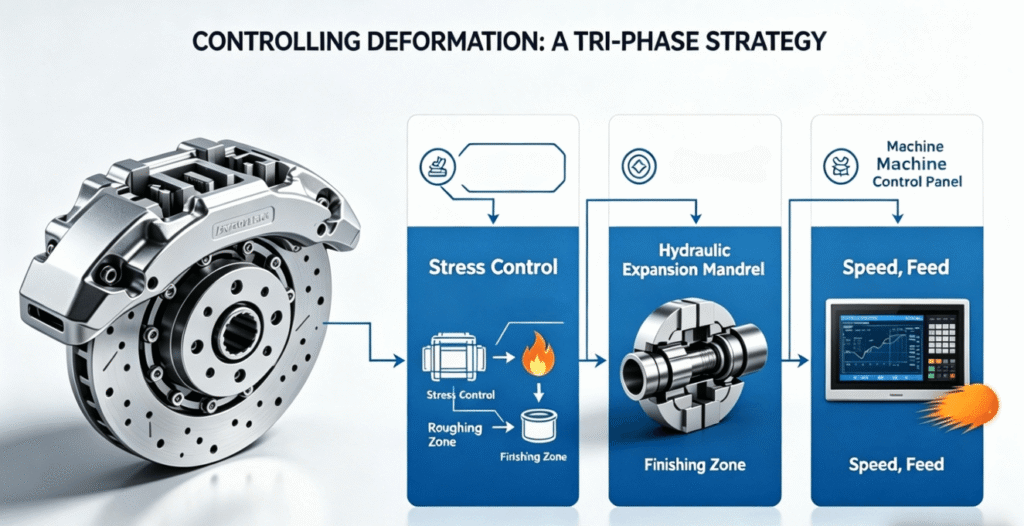
Thin-walled aluminum brake parts are highly susceptible to distortion during the CNC turning brake process due to internal stresses and cutting forces. Top-tier CNC turning process suppliers implement a “Triple-Control” strategy to meet the exacting standards of precision CNC machining automotive components.
A multi-stage machining sequence is critical. First, there is rough machining and then a separate stress-relieving cycle. The following semi-finishing, aging, and finish machining steps will be performed with a stable work piece. By taking this approach, any internal stresses which cause post-machining deformation can be systematically removed.
Hydraulic expansion mandrels and machined soft jaws will provide consistent, low distortion holding of the parts during manufacturing. In addition, the toolpaths will be set based on specific materials data using databases, and will also be run on machines fitted with dynamic balancing capabilities to counteract vibration. As a result, a precision CNC turning specialist can hold thin wall tolerances of ±0.05mm on a caliper body part.
What Additional Assurance Does Aerospace Certification (e.g., AS9100D) Bring to the Precision Manufacturing of Automotive Brake Parts?
Implementing AS9100D standard into precision CNC machining of automotive parts provides outstanding benefits owing to the extremely high control and traceability levels required by this standard, which is particularly important for critical parts.
AS9100D requires documentation of procedures for all manufacturing steps and their audit trails, which surpasses all requirements of standard automotive quality management system. It ensures a standardized, repeatable and traceable process for all batches of parts with minimal human error potential.
With AS9100D certification, First Article Inspection Report is mandatory for all manufactured products, and SPC is utilized in order to control critical characteristics throughout the process. This ensures that high precision CNC turning and control of critical characteristics such as piston roundness (e.g., ≤0.003mm), as well as surface roughness (Ra ≤0.4μm) is provided consistently between all produced batches, significantly lowering the risk of seal failures owing to dimension variations. For example, JS Precision, which is AS9100D, IATF 16949 and ISO 9001 certified company, illustrates this multiple-level systematic advantage.
How Can CNC Turning Applications Balance High Precision and High Flexibility for Low-Volume Custom Demands?
Modern brake system development, involving prototype validation and small-batch customization, requires both precision and agility. Advanced CNC turning applications address this through integrated methodologies.
Utilizing multi-axis turn-mill centers, complex components like monoblock calipers can be completed in a single setup. Operations such as turning, milling, and drilling are performed without re-clamping, eliminating cumulative errors and ensuring critical positional accuracies for complex OEM CNC turning parts.
Collaboration with a precision CNC turning company enables design optimization to consolidate multiple parts into a single, complex OEM CNC turning parts. A pertinent case involves integrating a piston and its retaining ring via combined turning and milling, achieving 15% weight reduction and entirely eliminating a potential leak path, enhancing reliability.
How Does Partnering with Professional Precision Turning Suppliers Optimize Total Cost of Ownership in the Long Run?
Moving beyond unit price, partnering with expert CNC turning process suppliers drives significant total cost optimization across the product lifecycle.
Proactive Cost Avoidance Strategies
Partnering with expert CNC turning process suppliers enables significant cost avoidance. Early Design for Manufacturability (DFM) analysis optimizes part geometry and tolerances, directly reducing machining complexity and material waste. This proactive collaboration minimizes downstream expenses before production even begins.
- DFM Driven Savings:
Collaborative design review identifies and rectifies manufacturability issues, preventing costly redesigns and scrap. - Quality Cost Reduction:
Stringent process controls yield near-zero defect rates, virtually eliminating warranty claims, recalls, and associated brand damage costs.
Value Creation Through Efficiency and Expertise
Long-term collaboration creates value beyond the unit price. Stable, optimized precision CNC turning processes and rapid response protocols drastically shorten time-to-market, accelerating revenue generation. The supplier’s deep application expertise acts as an extension of the client’s engineering team, solving complex material or geometric challenges to reduce costly trial and error, delivering measurable long-term savings.
Conclusion
Manufacturing automotive brake components is a precise balance of safety, performance, and cost. Each stage is critical: from the materials science of fit-for-purpose Custom Metal Parts, to deformation control in the CNC turning process, and the elevated standards of precision CNC machining automotive inspired by aerospace. Professional OEM turning services, by deeply integrating design and manufacturing, solve precision and performance bottlenecks while optimizing batch consistency and total cost of ownership. Manufacturers like JS Precision, with full certifications and proven expertise, serve as reliable extended manufacturing partners for OEMs and Tier-1 suppliers.
Do not let components become the weak link. Engage with a precision manufacturing expert holding dual IATF 16949 and AS9100D certification for a free manufacturability analysis of your brake assembly design, transforming concepts into safe, high-performance reality. If you have custom brake component or other precision part needs, welcome to immediately obtain professional DFM analysis and a transparent quote to start your project: Custom CNC Turning Services.
Author Bio
Author of the book works as a senior technical consultant in precision manufacturing. He has over 15 years experience in delivering Precision Manufacturing Services solutions to automotive & aerospace companies worldwide. Author’s specialization in the field includes OEM CNC turning parts.
FAQs
Q1: Which material would you recommend for brake calipers fabrication?
A: 6061-T6 aluminum alloy is commonly used. Also, you can try 7075-T651 alloy if you require stronger parts. The professionals from reputable manufacturers will help you to choose the right alloy depending on your loading conditions.
Q2: Which critical dimensional tolerances for brake pistons may be guaranteed by precision turning?
A: High-quality precision CNC turning may control piston diameter tolerance within ±0.01mm, roundness to ≤0.005mm, and Ra ≤0.4μm surface roughness. That allows having perfect seal and avoid fluid leakage.
Q3: How many pistons will be required in minimum order for custom brake pistons?
A: Most of reputable precision CNC turning providers can produce parts even from one piece and up to hundreds at a time. Therefore, you don’t have MOQ limits.
Q4: What is the time period between completion of drawings and delivery of samples of the brake components?
A: The lead time varies with complexity. Easy to make items could take 1 to 2 weeks, while more complicated monoblock calipers might need 2 to 4 weeks. Certain vendors provide fast-track service for known designs.
Q5: How can batch consistency be maintained when manufacturing thousands of such parts?
A: The system required includes standard procedures, SPC for critical dimensions, regular tool adjustment, machinery maintenance, as well as first and in-process inspection controls, making sure that batch consistency exceeds 99.8%.