India has always been known for its workforce, its entrepreneurial spirit and its growing economy. But for decades many products and technologies were imported heavily into the country. To reverse this trend and to boost domestic manufacturing, the Government of India launched the Make in India Initiative on 25 September 2014.
It is one of the most important economic programmes of India, which is aimed to make the country a global manufacturing hub. It encourages companies to manufacture products in India, promotes innovation, attracts foreign investment and creates employment opportunities for millions of people.
Even after a decade of its launch, the initiative is still shaping the industrial growth in India. The programme has gained new importance for India’s drive to be a developed nation by 2047 with growth in sectors like electronics, semiconductors, defence manufacturing, renewable energy and electric vehicles.
What is the Make in India Initiative?
It is a flagship initiative of the Government of India to facilitate investment, foster innovation, enhance skill development, protect intellectual property and build best-in-class manufacturing infrastructure. Its main objective is to increase the share of manufacturing in India’s economy and to create employment and improve infrastructure. The initiative aims to facilitate doing business in India by simplifying regulations, promoting investments and enhancing industrial capabilities. It also helps in developing new technologies and encourages the concept of “Made in India” products in the domestic and international markets.
Quick Facts About Make in India Initiative
| Particulars | Details |
| Scheme Name | Make in India Initiative |
| Launched On | 25 September 2014 |
| Launched By | Prime Minister Narendra Modi |
| Ministry | Ministry of Commerce and Industry |
| Main Objective | Promote manufacturing and investment |
| Current Phase | Make in India 2.0 |
| Sectors Covered | 27 sectors (15 manufacturing and 12 services) |
| Official Focus | Manufacturing, Innovation, Infrastructure, Employment |
Objectives of the Make in India Initiative
The major objectives include:
- Increasing manufacturing’s contribution to GDP.
- Creating large-scale employment opportunities.
- Encouraging domestic and foreign investments.
- Promoting innovation and entrepreneurship.
- Improving ease of doing business.
- Building world-class infrastructure.
- Reducing import dependence.
- Enhancing exports from India.
The long-term vision is to establish India as a global center for manufacturing, design, and innovation while supporting sustainable economic development.
Four Pillars of Make in India Initiative
The success of Make in India Initiative rests on four key pillars:
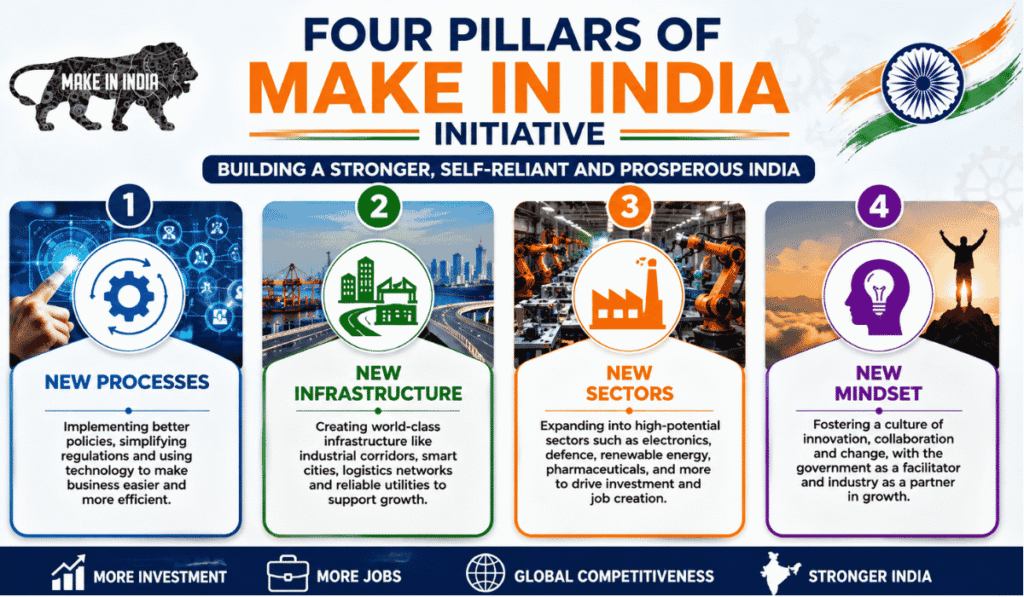
1. New Procedures
The government has introduced reforms to make doing business easier. Digitisation, reduced compliance requirements and National Single Window System have improved ease of doing business.
2. New Infrastructure
Industrial corridors, logistics parks and smart cities are being developed to provide world class infrastructure to industries.
3. New Sectors
The first programme covered 25 sectors. The focus in Make in India 2.0 has expanded to 27 sectors such as electronics, defence, textiles, renewable energy and pharmaceuticals.
4. New Mindset.
The government wants to be a facilitator and not just a regulator, fostering collaboration between industry and policy makers.
Sectors Covered Under Make in India
It covers a wide range of industries, including:
- Automobile
- Defense Manufacturing
- Electronics
- Pharmaceuticals
- Renewable Energy
- Biotechnology
- Food Processing
- Railways
- Aviation
- Chemicals
- Textiles
- Construction
- Mining
- Tourism
- Information Technology
- Space Technology
These sectors have been selected based on their potential to generate employment, attract investment, and increase exports.
Major Achievements of the Make in India Initiative
It has touched several milestones over the years: Manufacturing Growth India is an important manufacturing hub for smartphones, electronics and automotive products.
Increase in Foreign Direct Investment (FDI)
Investor-friendly policies have led to a significant jump in FDI inflows across sectors in India.
Production-Linked Incentive (PLI) Schemes
The government has launched PLI schemes to boost domestic manufacturing in strategic sectors. By early 2026, PLI schemes drew investments of over ₹2.16 lakh crore and resulted in substantial production output and job opportunities.
Defence Manufacturing Strengthening
India has lowered its reliance on imported defence equipment and increased its domestic production capacity.
The Rise of Electronics
India has emerged as one of the top destinations in the world for manufacturing mobile phones with many big global companies establishing their manufacturing units in the country.
Make in India 2.0
The government introduced Make in India 2.0 to further strengthen manufacturing and service sectors. The updated version focuses on:
- Advanced manufacturing.
- Electronics and semiconductor production.
- Green energy.
- Industrial innovation.
- Global supply chain integration.
- Emerging technologies.
Today, Make in India 2.0 covers 27 sectors and aligns with broader initiatives such as Digital India, Startup India, PM Gati Shakti, and Atmanirbhar Bharat.
Latest Updates on Make in India Initiative (2026)
It continues to evolve in 2026 with several developments:
- Expansion of PLI schemes across strategic sectors.
- Increased focus on semiconductor manufacturing.
- Growth in hydrogen and green energy projects.
- Continued investment in industrial infrastructure.
- Greater emphasis on innovation-driven manufacturing.
India’s manufacturing ecosystem is also benefiting from initiatives related to electric mobility, industrial corridors, and digital infrastructure, supporting the country’s ambition to become a developed economy by 2047.
Benefits of Make in India Initiative
The initiative offers several advantages:
| Benefit | Impact |
| Job Creation | Millions of employment opportunities |
| Increased Investment | Higher domestic and foreign investments |
| Better Infrastructure | Improved industrial facilities |
| Export Growth | Enhanced global competitiveness |
| Innovation | Support for startups and technology |
| Economic Growth | Stronger manufacturing ecosystem |
These benefits contribute to long-term economic development and improved living standards across the country.
Challenges Faced by Make in India Initiative
Despite its achievements, It faces some challenges:
- Land acquisition issues.
- Skill gaps in certain industries.
- Infrastructure bottlenecks.
- Global economic uncertainties.
- Competition from established manufacturing nations.
- Supply chain limitations.
Experts believe that continued reforms, investment in skill development, and improved logistics will help address these challenges over time.
Make in India and Atmanirbhar Bharat
The Make in India Initiative and Atmanirbhar Bharat complement each other. While Make in India focuses on manufacturing and investment, Atmanirbhar Bharat emphasizes self-reliance and reducing import dependency.
Together, these initiatives aim to:
- Boost domestic production.
- Encourage local industries.
- Promote exports.
- Create sustainable employment.
- Strengthen India’s global position.
Read More: Mission Shakti Scheme | Startup India Scheme
Why is Make in India Important?
The importance of the Make in India Initiative can be understood through its impact on India’s economy:
- Supports industrial development.
- Encourages entrepreneurship.
- Creates employment opportunities.
- Improves India’s global competitiveness.
- Attracts international businesses.
- Helps achieve the vision of Viksit Bharat 2047.
As global companies diversify their supply chains, India has an opportunity to establish itself as a reliable manufacturing destination.
Future of Make in India Initiative
The future is bright. With government support, infrastructure development and increasing investor confidence, India is set to grow its manufacturing capabilities. New sectors such as semiconductors, artificial intelligence, electric vehicles, green hydrogen and advanced electronics are expected to play a major role in the next phase of industrial growth. If the current momentum keeps up, the initiative could make a significant contribution towards India’s goal of becoming a multi-trillion dollar economy over the coming decades.
Conclusion
The Make in India Initiative has transformed the perception of India’s manufacturing potential across the world. The initiative has become a critical pillar of India’s economic strategy, from attracting investments to creating jobs and spurring innovation. Despite ongoing challenges, policy support and technological progress are setting India on a trajectory to become a global manufacturing powerhouse. With the country marching towards Viksit Bharat 2047, the Make in India Initiative will continue to remain integral to shaping India’s future.
FAQs Related to Make in India Initiative
1. What is the Make in India Initiative?
The Make in India Initiative is a flagship government program launched in 2014 to promote manufacturing, attract investments, and create employment opportunities in India.
2. Who launched the Make in India Initiative?
Prime Minister Narendra Modi launched the Make in India Initiative on September 25, 2014.
3. What are the four pillars of the Make in India Initiative?
The four pillars are New Processes, New Infrastructure, New Sectors, and New Mindset.
4. How many sectors are covered under Make in India 2.0?
Make in India 2.0 currently focuses on 27 sectors, including manufacturing and services
5. What is the main objective of the Make in India Initiative?
Its primary objective is to transform India into a global manufacturing hub while creating jobs and promoting economic growth.